
Our educational approach
Education at Ein Bustan brings together two central foundations: Waldorf education, which places the child, nature, and development at an individual pace at the center; and bilingual education, in which Hebrew and Arabic are a natural part of everyday life.
The combination of the two creates an educational environment in which Jewish and Arab children grow up together from an early age, learn to know themselves and the other, and form bonds through play, making, and shared experiences.
In our toddler group and kindergarten, for ages 1–6, we seek to give every child a safe, warm, and lively space in which they can discover the world at their own pace.
Waldorf education
What is Waldorf education?
Waldorf education grew out of the educational approach of the philosopher and educator Rudolf Steiner. At the center of the approach is the understanding that children learn and develop through experience, imitation, movement, play, and encounter with the world around them. In the early years, the emphasis is on creating a stable environment, rich in sensory experiences and human relationships, that allows children to develop at their own pace.
These are some of the principles that guide early-childhood education:
Rhythm and cyclicality
A day, week, and year with a steady, familiar rhythm. Times for play, meals, songs, and stories interweave with the seasons and the holidays, and give children a sense of security and belonging.
Free play
Play is a central part of the child’s world. Through it, children develop imagination, try things out, explore, form relationships, and learn to cope with new situations. That is why significant time and space are devoted to free play every day.
Learning through imitation and doing
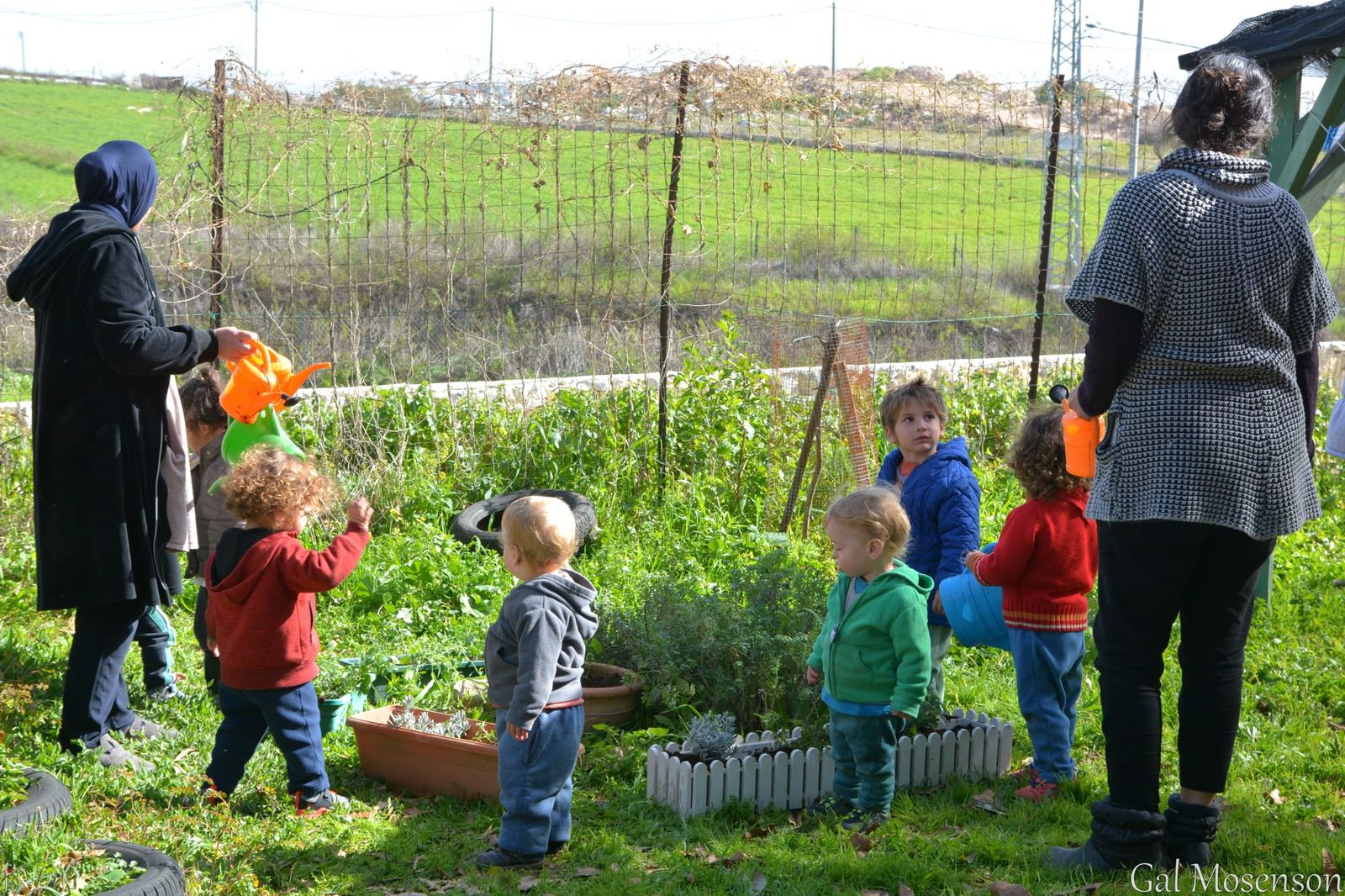
Young children learn a great deal by watching adults and imitating their actions. Baking, gardening, cooking, cleaning, and mending are part of kindergarten life, and the children are invited to take part according to their age and their wish.
Art, nature, and natural materials
Singing, stories, painting, handwork, and play with natural materials are an inseparable part of everyday life. Being outdoors and meeting nature and the seasons lets children explore, try things out, and discover their surroundings through the senses and through experience.
And how does this look at Ein Bustan?
- Songs, stories, and blessings: Hebrew and Arabic accompany the rhythm of the day, in songs, stories, blessings, and conversations between the children and the staff.
- Play and work in nature: The children spend time in the yard, tend the beds, plant, play, and watch the changes the seasons bring. At Gan Dalia there is also a regular forest day, once a week.
- Making and handwork: Baking, weaving, painting, and work with natural materials let children try things out, create, and develop independence and imagination.
- Holidays and traditions: Throughout the year we mark Jewish, Muslim, and Christian holidays and occasions together. Each culture brings its songs, stories, and customs, and all become part of the shared experience.
- Listening and mutual respect: We aim to create an environment in which every child feels seen and heard, with listening that comes from compassion, acceptance, and without judgment.
We believe that every child has their own path and pace of development. Our role is to accompany them with patience, give them security and a place to try things out, and let them discover the world out of curiosity and joy.
Bilingual education
Two languages, together every day
At Ein Bustan, Hebrew and Arabic are an inseparable part of everyday kindergarten life. Jewish and Arab children grow up together from an early age, meet the language and culture of the other, and learn to know one another’s world. Difference in language, tradition, and custom does not divide them; it becomes a natural part of a shared life.
How does this look at Ein Bustan?
Two languages, one space
In every kindergarten a team of Hebrew and Arabic speakers works. Both languages are present throughout the day, in conversation, play, meals, and shared activities. Every child can express themselves in their language and feel they belong.
A community of children and families
We aim, as far as possible, to keep a balance between the number of Hebrew-speaking and Arabic-speaking children. The meeting among the children continues into the families, and creates a community of parents, staff, and children from different backgrounds.
Shared holidays and traditions
Throughout the year we mark Jewish, Muslim, and Christian holidays and occasions together. The songs, stories, and customs of both cultures have a place in kindergarten life, and the children learn to know and respect the different traditions.
Belonging and mutual respect
We seek to create an environment in which every child and family feel at home, regardless of the language they speak or the culture they come from. Hebrew and Arabic are given an equal place, and the differences among us are seen as a source of enrichment, of getting to know one another, and of friendship.
For our children, a shared life is not a vision for the future. It is simply part of childhood.
Would you like to visit?
You're welcome to come, meet the staff and ask anything. We'd be glad to hear from you, in Hebrew or in Arabic.